
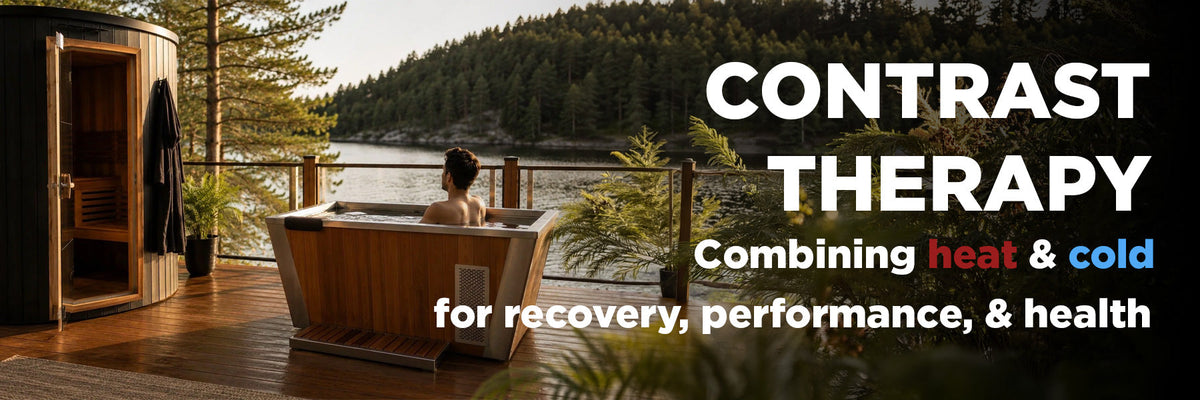
Recovery has become an increasingly important part of how I approach fitness, performance, and long term health. After years of competing in obstacle course racing, endurance events, and competitive functional fitness, I have learned that training itself is only one part of the equation. You can have a great program, train hard, eat well, and stay consistent, but eventually your ability to recover becomes one of the biggest factors determining how much productive training you can tolerate. This becomes even more important when training has to coexist with work, family, competitions, travel, and normal life.
One of the recovery methods I have enjoyed incorporating into my routine is contrast therapy, or deliberately alternating between heat and cold exposure. I have used sauna and cold exposure independently, but I personally enjoy them much more when they are combined into one recovery session. The dramatic transition between temperatures creates an entirely different experience than using either one by itself, and it gives me a dedicated period where the goal is simply to recover rather than adding more training.
I do not look at contrast therapy as something that replaces sleep, nutrition, hydration, intelligent programming, mobility, or appropriate rehabilitation. Those fundamentals remain much more important. Instead, I see contrast therapy as another tool that can complement them. Heat and cold create very different physiological responses, and alternating between the two creates a controlled environmental stress that the body continually has to adjust to. For athletes, that can be useful as part of a larger recovery strategy, but you certainly do not have to be a competitive athlete to incorporate contrast therapy into a healthy lifestyle.
Heat and Cold: The Basics
Before getting into contrast therapy itself, it helps to understand what happens at each end of the temperature spectrum. Heat exposure increases skin blood flow, causes peripheral blood vessels to dilate, increases sweating, and requires the cardiovascular system to work harder to regulate body temperature. Heart rate can increase even though you are sitting still, while muscles and joints often feel warmer and more relaxed. Regular heat exposure is also interesting from the standpoint of thermoregulation and heat acclimation, particularly for athletes who train and compete in hot environments.
Cold exposure creates a very different response. Peripheral blood vessels constrict, breathing can initially become faster, and the sudden temperature change creates a strong nervous system response. Cold water immersion has been used in sports recovery for years because it can help reduce the perception of muscular soreness and discomfort following demanding exercise. It can also produce a noticeable feeling of alertness. When the water is genuinely cold, the first few moments require deliberate control of your breathing and attention to how your body is responding.
There is considerably more that could be discussed about heat and cold individually, but for this article the most important point is that they create opposing thermal environments. Heat encourages the body to release heat while cold forces it to conserve heat. Contrast therapy takes advantage of those differences by deliberately moving between them within the same recovery session.
What Is Contrast Therapy?
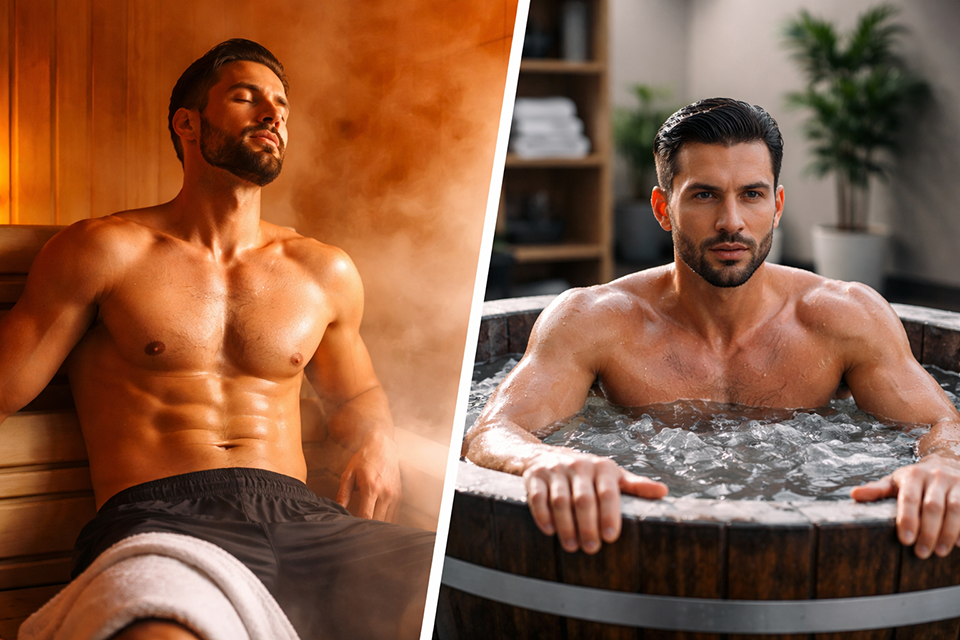
Contrast therapy is the deliberate alternation between hot and cold environments. Traditionally, much of the sports recovery research has examined contrast water therapy, where athletes move between warm and cold water for several rounds. More recently, sauna followed by cold plunging has become another popular way to apply the same general concept.
The transition between temperatures is what makes contrast therapy unique. When you spend enough time in a hot environment, body temperature rises, skin blood flow increases, and sweating becomes progressively heavier. Moving into cold water suddenly reverses the environmental challenge. Peripheral blood vessels constrict, skin temperature falls, breathing changes, and the body begins trying to conserve heat rather than release it. Returning to the heat creates another transition, and repeating that process requires the body to continually adjust its thermoregulatory response.
Contrast therapy is sometimes described as producing a pumping effect because heat encourages peripheral vasodilation while cold encourages vasoconstriction. That is a useful basic way to visualize what is happening, but I would be careful with some of the exaggerated claims surrounding this idea. Alternating temperatures does not magically flush every toxin or waste product out of the muscles. What we can reasonably say is that temperature has a significant effect on blood vessel behavior, circulation, skin blood flow, nervous system activity, and thermoregulation, and contrast therapy repeatedly changes those demands during a single session.
For me, the subjective effects are just as important. Heat leaves me feeling relaxed and loose, while cold tends to leave me feeling awake and refreshed. Combining the two gives me both experiences within one session, which is one of the main reasons I prefer contrast therapy over exclusively using one temperature.
What Does a Contrast Therapy Protocol Look Like?
One of the biggest misconceptions surrounding contrast therapy is that there is one scientifically established temperature or timing ratio everyone needs to follow. There really is not. Research has used a surprisingly wide range of temperatures, durations, and numbers of rounds depending on what researchers were studying and who was participating.
In studies specifically examining contrast water therapy after exercise, total treatment times have commonly fallen somewhere around 6 to 24 minutes. Cold water temperatures have often been roughly 46 to 59 degrees Fahrenheit, while warm water has generally been somewhere around 96 to 113 degrees. Some protocols have alternated approximately 1 minute warm with 1 minute cold for several rounds. Others have used 2 minutes warm followed by 1 minute cold, or approximately 3 minutes warm followed by 1 minute cold. The exact numbers vary, but the common feature is repeatedly exposing the body to distinctly different temperatures.
This research provides a useful framework, but it is important to understand that contrast water therapy is not identical to moving between a traditional sauna and cold plunge. Sitting in 100 degree water is very different from sitting in sauna air approaching 180 degrees. Water and air transfer heat differently, and the temperatures cannot simply be compared number for number. Someone using warm and cold tubs may transition every minute or two, while someone using a traditional sauna may spend considerably longer in the heat before transitioning into a shorter period of cold.
That is why I think a contrast protocol should be viewed as a framework rather than an exact prescription. There needs to be a meaningful temperature difference, enough exposure to actually experience each environment, and a duration that is appropriate for the person using it. Someone who is completely new to cold exposure does not need to immediately jump into 40 degree water, just as a new sauna user does not need to start at the highest possible temperature for 30 minutes. The goal is creating a repeatable physiological challenge, not winning a competition over who can tolerate the most extreme temperatures.
One Round Versus Multiple Rounds
A single transition from heat into cold is probably the simplest way to practice contrast therapy. Spend enough time in the heat to become thoroughly warm, then transition into a shorter period of cold. This can be an easy option when time is limited or when someone simply enjoys using heat and finishing with cold.
Multiple rounds create a somewhat different experience because the body has to repeatedly adjust between opposing thermal environments. Heat is followed by cold, then the body returns to heat before being exposed to cold again. Many of the contrast water therapy protocols used in sports research have taken this approach, using several relatively short cycles instead of one extremely long period at each temperature.
I personally enjoy performing multiple rounds when I have more time and want a dedicated contrast session, but I would not claim that two, four, or six rounds are automatically better than one. More is not always better with recovery modalities. Longer sessions create more total thermal stress, while additional sauna exposure also means more sweating and fluid loss. Eventually a recovery session can become stressful enough that you are creating additional fatigue rather than supporting recovery.
For most people, I think the better approach is finding the smallest practical dose that produces the experience and response they are looking for. If one heat and cold transition leaves you feeling great, there is no requirement to perform five more rounds simply because another protocol does.
My Personal Contrast Therapy Setup and Protocol
My own routine has developed through experience rather than because I believe I have found the perfect scientific ratio. At home, I use a three person traditional sauna along with a barrel cold plunge connected to a dedicated water chiller. Having both available at home makes the process extremely convenient and allows me to keep the temperatures consistent instead of continually buying ice or traveling somewhere for recovery sessions.
My traditional sauna is typically around 180 degrees Fahrenheit and I keep my cold plunge around 43 degrees. If I am doing a simple single round session, I generally spend approximately 20 minutes in the sauna and then finish with around 5 minutes in the plunge. If I want more of a repeated contrast session, I shorten the exposures and typically perform approximately 15 minutes in the sauna followed by 3 minutes in the cold plunge, then repeat that sequence one more time.
Those numbers are what work for me. They are not what I would tell everyone else to immediately copy. I have gradually adapted to both environments, and I know how my body responds to those temperatures. My sauna exposure is also much longer than the warm portions of many laboratory contrast protocols because I am using high temperature sauna air rather than warm water immersion.
I think that distinction is important because people can become unnecessarily focused on exact numbers. Someone sees an athlete using 40 degree water and assumes 50 degrees is not cold enough, or hears that someone sits in a sauna for 30 minutes and assumes a shorter session accomplishes nothing. Research has successfully used a variety of temperatures, durations, and ratios. The better approach is to understand the basic principles, begin conservatively, and find something that is sustainable for your own body and goals.
Why I Prefer to Finish With Cold
For my normal contrast sessions, I prefer to finish with cold. After spending time in a hot sauna and sweating heavily, I do not necessarily want to finish the session still overheated and continue sweating afterward. The cold plunge rapidly changes how I feel and gives the session a clear endpoint. I get out feeling cool, awake, and refreshed instead of hot and still trying to bring my body temperature back down.
There is also a mental component that I enjoy. When I move from a hot sauna into 43 degree water, the first moments demand my full attention. I have to deliberately control my breathing, relax, and allow the initial cold response to settle rather than immediately reacting to the discomfort. Once I get through those first moments, the water becomes much more manageable, and getting out after the final cold exposure gives me the feeling that the session is complete.
Finishing cold is my preference rather than an absolute rule everyone needs to follow. Someone using heat primarily for relaxation immediately before bed may prefer finishing warm if cold exposure makes them extremely alert. Athletes should also think about when they are using aggressive cold exposure around resistance training. Frequent immediate cold water immersion after strength training may interfere with some of the cellular signaling associated with muscular adaptation and hypertrophy. If maximizing muscle growth is the priority, I would not automatically jump into very cold water immediately after every lifting session.
For a dedicated contrast therapy session, however, I personally like heat followed by cold and generally prefer the cold exposure to be the final part of the session.
Contrast Therapy for Athletic Recovery and Performance
My background includes competitive functional fitness, obstacle course racing, endurance events, running, and years of strength and conditioning. While those activities place different demands on the body, the recovery requirements overlap considerably. Hard training can create muscular soreness, cardiovascular stress, connective tissue loading, nervous system fatigue, and general physical exhaustion. Whether that comes from running hills and obstacles, lifting heavy weights, performing high intensity conditioning, or combining all of those within the same competition weekend, eventually your ability to recover becomes part of your ability to perform.
This is where contrast therapy fits into my own training. I am not expecting a sauna and cold plunge to erase the physiological cost of a difficult workout or competition. My body still needs adequate calories, protein, carbohydrates, fluids, electrolytes, sleep, and time. Instead, contrast therapy becomes another piece of that recovery process. Heat gives me a chance to relax and can make my body feel less stiff, while the cold portion can help with the perception of soreness and leave me feeling noticeably more refreshed.
Timing also matters because recovery and adaptation are not exactly the same thing. Training intentionally creates stress, and some of the body's response to that stress is what eventually makes us stronger and fitter. I do not think athletes need to immediately eliminate every uncomfortable sensation after every workout. During normal training, I want my body to adapt to the work I am doing. During a competition or a particularly demanding training period, the goal may be different. If I need to compete again later that day or the following morning, feeling less sore and more prepared to perform may become a higher priority.
This is why I view contrast therapy as a tool rather than something that has to happen after every workout. Some days a full contrast session makes sense. Other days the best recovery strategy is simply eating a good meal, replacing fluids, getting enough sleep, and allowing the body to adapt naturally.
The Mental Side of Contrast Therapy
One of my favorite aspects of contrast therapy has very little to do with muscle soreness. Cold exposure forces me to become present. When I step from a hot sauna into cold water, my body does not care about work, my phone, tomorrow's workout, or anything else I was thinking about a few seconds earlier. My immediate job becomes controlling my breathing and settling into an uncomfortable environment.
I think there is useful crossover for athletes here. Competition regularly puts you into situations where discomfort is unavoidable. Your heart rate is high, your muscles are tired, the workout hurts, or you are several miles into a race and still have a long way to go. Panicking or becoming frustrated does not improve the situation. You have to remain composed and continue working. Cold exposure gives me another controlled environment where I can practice remaining calm while my body is telling me that it would rather be somewhere else.
I would not claim that cold plunging automatically creates mental toughness, but I do think there is value in practicing controlled breathing and composure during discomfort. The entire contrast session also gives me something productive to do on recovery days without turning an easy day into another workout. Athletes can be terrible at resting, and sometimes having a recovery activity makes it easier to actually recover.
Contrast Therapy for General Health and Longevity
You certainly do not have to be a competitive athlete to use contrast therapy. For the average person, some of the most interesting aspects are the cardiovascular and thermoregulatory response to heat, the nervous system and vascular response to cold, relaxation, and the simple act of deliberately exposing the body to changing environmental conditions.
Most of us spend an enormous percentage of our lives in climate controlled environments. We move from a temperature controlled home to a vehicle and then into another climate controlled building. Heat and cold create manageable environmental challenges that require the body to actively respond. That broader concept is one reason deliberate temperature exposure interests me from a general health and longevity perspective.
There is also the relaxation and stress management component. A contrast session creates a period where I am not training, working, staring at my phone, or trying to accomplish five things at once. The heat encourages me to sit still, while the cold forces me to focus on my breathing and the immediate environment. Even without trying to attach a laboratory measurement to every minute of the session, I find value in having a routine that creates that separation from the rest of the day.
I would still place contrast therapy below the major foundations of long term health. Regular exercise, maintaining muscle mass, cardiovascular fitness, nutritious food, adequate sleep, healthy body composition, avoiding smoking, maintaining relationships, managing stress, and addressing major health risks are far more important than owning a sauna or cold plunge. Contrast therapy should complement those habits rather than distract from them.
Contrast Therapy Does Not Require Expensive Equipment
My home setup makes contrast therapy extremely convenient, but specialized equipment is not necessary to experience the basic concept. Someone at a gym can use a traditional sauna followed by a cold shower. A steam room or hot tub can provide heat before transitioning into a cool or cold shower or pool. At home, a hot bath followed by progressively colder shower water provides an inexpensive introduction. Recovery facilities may also offer traditional or infrared sauna, cold plunges, and cryotherapy.
These methods do not produce identical physiological effects, and they do not need to. A cold shower is different from being submerged in 43 degree water, just as an infrared sauna differs from a traditional high temperature sauna. The goal is not to recreate someone else's setup perfectly. It is to create a meaningful temperature contrast using whatever safe and practical options you actually have access to.
Beginners should also build tolerance gradually. There is no reason someone completely new to heat and cold needs to immediately copy the temperatures or durations used by experienced athletes. Start with manageable temperatures and shorter durations, see how your body responds, and gradually adjust from there. The best protocol is not necessarily the most extreme one. It is the one you can use safely and consistently.
Hydration and Safety
Contrast therapy creates real physiological stress, and that needs to be respected. Heat exposure can produce substantial sweating and fluid loss, particularly if the session follows a long run, outdoor workout, competition, or another activity where you were already sweating heavily. Water and electrolytes both matter, and I would rather address dehydration before getting into a very hot sauna than assume additional sweating is somehow automatically beneficial.
People with cardiovascular conditions, uncontrolled blood pressure problems, a history of fainting, difficulty regulating body temperature, pregnancy, or other significant medical concerns should discuss intense heat or cold exposure with an appropriate healthcare professional. Alcohol should not be mixed with extreme temperature exposure, and deliberate hyperventilation or breath holding exercises should never be performed around water. If you become dizzy, confused, nauseated, unusually weak, or simply feel that something is wrong, get out. Recovery should never become another activity where warning signs are ignored in pursuit of a number on a timer.
How Contrast Therapy Fits Into My Overall Recovery
After years of competing and training, I have become increasingly interested in the recovery side of performance. Training teaches you how to create stress, but experience eventually teaches you how important it is to recover from it. Contrast therapy has become one of my favorite tools because it is simple, repeatable, and creates a completely different challenge than the physical loading I already get from running, lifting, carrying, and conditioning.
Most importantly, I do not use contrast therapy because I believe it magically erases hard training. Sleep, nutrition, hydration, intelligent programming, and time remain the foundation of recovery. I use contrast therapy because alternating heat and cold gives me dedicated time to recover, exposes my body to controlled changes in temperature, helps me manage how I feel between demanding training sessions, and provides a physical and mental reset that I genuinely enjoy.
There is also something satisfying about the simplicity of the process. Get thoroughly warm, spend enough time there for the heat to become challenging, transition into the cold, control your breathing, and allow your body to adjust. If you want a longer session, return to the heat and repeat the process. You do not need to chase the hottest sauna, the coldest plunge, the longest exposure, or the greatest number of rounds.
The research itself reinforces that there is no single perfect formula. Different protocols use different temperatures, durations, and ratios, and my own routine is simply what I have found works well for me. Someone else's ideal protocol may look completely different.
For me, that flexibility is part of what makes contrast therapy so practical. Whether I am recovering from functional fitness training, endurance work, or simply using it as part of an overall approach to staying strong and healthy for the long term, contrast therapy gives me another way to deliberately focus on recovery without adding more training. It is not a shortcut, and it does not replace the fundamentals, but used intelligently, it has become a valuable and enjoyable part of my approach to recovery, performance, and long term health.
About The Author

My work focuses on bridging exercise science, biomechanics, connective tissue adaptation, and practical equipment applications so people can better understand how training can be structured with more intention. Through my content, I break down strength training concepts, gym equipment setups, and programming strategies in a way that is technically grounded, but still practical for coaches, lifters, and home gym owners. My goal is not just to show what exercises to perform, but to explain why specific tools, loading strategies, and movement setups can create better training outcomes. At The Tissue Lab, I work with clients in a private gym setting, using individualized strength training, mobility work, and progressive loading strategies to help improve performance, build resilience, and support long-term physical development.
Build Your Dream Home Gym with Ironmaster
Since 1978, Ironmaster has been trusted by serious lifters and home gym enthusiasts for delivering the best in heavy-duty, modular strength equipment built to last a lifetime. Whether you’re just getting started or upgrading your existing setup, Ironmaster.com has everything you need to train smarter at home—without compromising on quality. Start with the foundation: the legendary Super Bench Adjustable Weight Bench, known for its rock-solid stability and unmatched versatility. Then, level up your workouts with our Quick-Lock Adjustable Dumbbells, a fan-favorite for their rapid adjustability and space-saving, plate-sharing design. Need serious strength training capabilities? Add the all-in-one IM2000 Self-Spotting Machine, a hybrid Smith-style half rack that makes it easy to lift heavy safely, even when training alone. With dozens of compatible attachments, you can outfit a full-body gym in your garage, basement, or spare room.
Ready to save? Use our Custom Package Builder to bundle your favorite equipment and unlock automatic discounts—the more you bundle, the more you save


